Introduction With increasingly stringent emission standards in Europe and the United States—Euro 7, EPA HD 2027, CARB HD Omnibus—heavy duty diesel trucks must sustain ultra low NOx emissions across every duty cycle. The NOx sensor now sits at the heart of SCR (Selective Catalytic Reduction) systems, delivering real time data that drives precise diesel exhaust fluid (DEF) dosing and keeps fleets compliant over hundreds of thousands of miles. In Class 6–8 vehicles, NOx sensors have evolved from s…
NOx Sensor Structural Analysis for EU/US Heavy-Duty Diesel Trucks


Introduction
With increasingly stringent emission standards in Europe and the United States—Euro 7, EPA HD 2027, CARB HD Omnibus—heavy-duty diesel trucks must sustain ultra-low NOx emissions across every duty cycle. The NOx sensor now sits at the heart of SCR (Selective Catalytic Reduction) systems, delivering real-time data that drives precise diesel exhaust fluid (DEF) dosing and keeps fleets compliant over hundreds of thousands of miles. In Class 6–8 vehicles, NOx sensors have evolved from simple measurement devices into closed-loop feedback actuators for ECUs, directly influencing urea consumption, SCR efficiency, and derate behavior.
This article provides a structural and functional overview tailored to EU and US heavy-duty platforms, highlighting the sensor’s core components, operating principles, durability strategies, and SCR integration.
Overview of Sensor Architecture
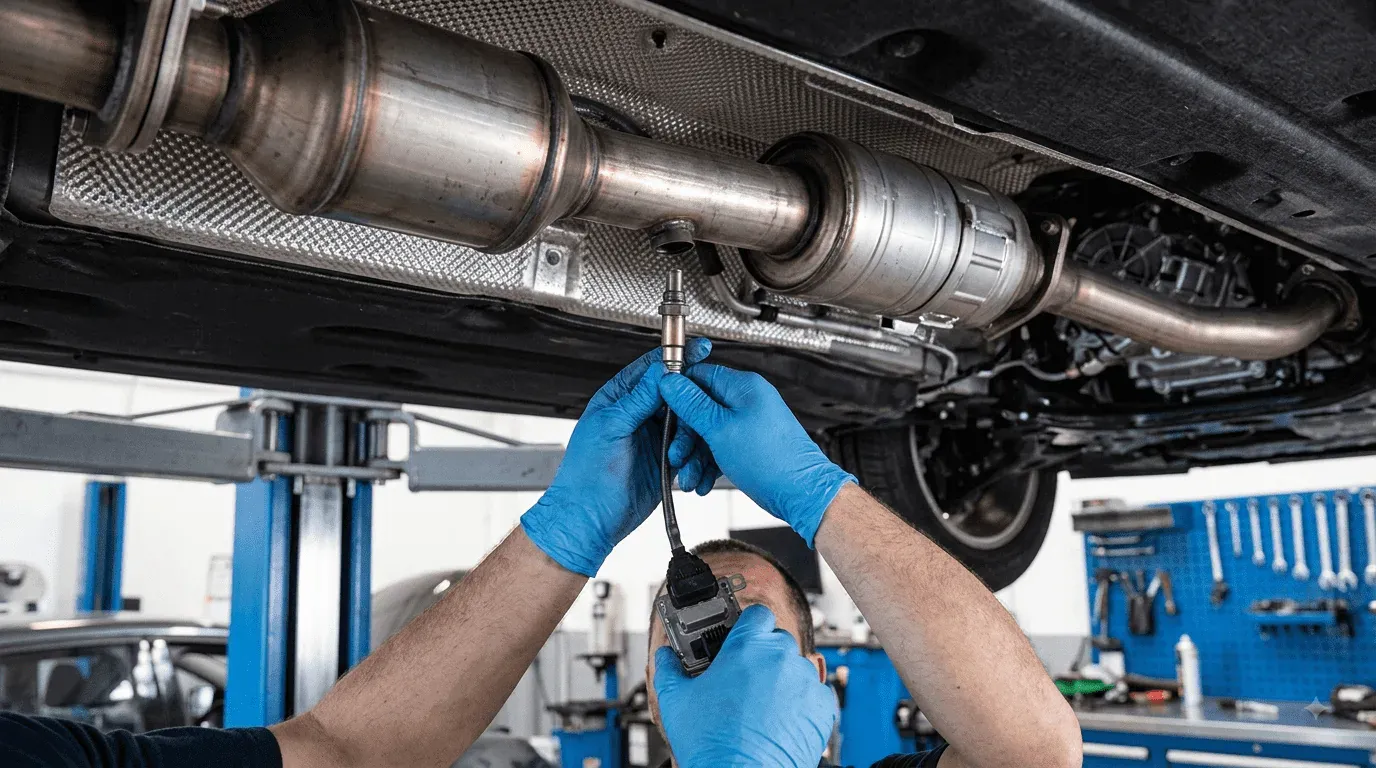
Modern heavy-duty NOx sensors are split into two assemblies:
- Sensor Probe – the high-temperature electrochemical module installed in the exhaust stream.
- Sensor Control Unit (SCU) – an external electronics package that supplies power, manages pump currents/heater control, runs diagnostics, and exchanges data with the ECU via CAN/J1939.
The probe combines electrochemical cells, catalytic conversion, diffusion channels, and precision thermal management to deliver reliable NOx measurements under high-temperature, high-vibration conditions.
Core Components
1. Multilayer Ceramic Substrate
- Zirconia (ZrO₂) solid electrolyte supports both oxygen and NOx pump cells.
- Houses diffusion-limiting channels and reference air passages.
- Offers mechanical strength above 800 °C with minimal thermal expansion.
The multilayer stack enables tight gas control while maintaining the electrochemical cells in a stabilized micro-environment.
2. Oxygen Pump Cell (Pump Cell 1)
- Uses zirconia’s oxygen-ion conductivity to shuttle O²⁻ ions in/out of the chamber.
- Applies a voltage to maintain constant oxygen partial pressure.
- Generates pump current I₁ proportional to local oxygen content.
This cell decouples NOx measurement from fluctuating exhaust oxygen caused by EGR or transient fueling.
3. NOx Decomposition Catalyst Layer
- Catalyst formulations (Pt/Rh, CeO₂ storage materials, sulfur-resistant additives) convert NO/NO₂ into N₂ and oxygen ions.
- Reaction:
NOx → ½ N₂ + O²⁻ - Must withstand sulfur, DEF crystals, and thermal cycling without loss of activity.
4. NOx Pump Cell (Pump Cell 2)
- Removes the oxygen released by the catalyst.
- Pump current I₂ scales directly with NOx concentration and forms the primary measurement signal.
- Dual-pump design provides linear response and accuracy over wide ppm ranges.
5. Diffusion Barrier
- Microporous ceramic or laser-drilled membrane moderates exhaust flow.
- Filters particulates, reduces transient spikes, and protects the reaction chamber.
- EU sensors emphasize steady-state accuracy; US designs are tuned for fast transient tracking in stop-and-go duty.
6. Integrated Heater
- Thin-film heater keeps the sensing zone at 650–800 °C.
- Typical power: 7–18 W with PWM control from the ECU/SCU.
- 2025 designs reach operating temperature within 20–40 s, critical for cold-start compliance.
7. Housing and Protection Tube
- Inconel or high-grade stainless steel with multilayer shields and sintered filters.
- Resists vibration, moisture, corrosive gases, soot, and DEF crystallization.
- Maintains exhaust sealing while allowing diffusion-controlled gas entry.
8. Sensor Control Unit (SCU)
- Located off-probe to protect electronics from heat.
- Drives pump cells/heater, measures currents, and computes NOx ppm via gas models.
- Provides self-diagnostics (open/short, poisoning, heater fault) and communicates over CAN/J1939.
- Supports predictive maintenance and derate avoidance by reporting early degradation.
Integration into SCR Systems
- Upstream sensor: measures engine-out NOx, supports EGR/fueling control, and establishes DEF dosing baseline.
- Downstream sensor: verifies SCR conversion efficiency, monitors ammonia slip, and fulfills RDE / in-use compliance.
Together they close the loop on DEF control, ensure emission compliance, and protect fleets from costly derates.
Durability & Market-Specific Considerations
- Euro 7 focus: Low-temperature accuracy (down to 150–200 °C exhaust), rapid heater warm-up, cold-start robustness, RDE compliance.
- US CARB/EPA focus: Durability up to 435k–600k miles, high accuracy during idle/low-load, stringent OBD diagnostics with fault-specific derate logic.
- Reinforced ceramics, vibration-resistant heaters, sulfur-tolerant catalysts, and contamination-resistant housings are standard in 2025 sensor generations.
Conclusion
NOx sensors are now strategic control elements for Euro 7 and EPA HD 2027 fleets. Their structural design—dual pump cells, catalytic conversion, managed diffusion, and intelligent SCUs—enables precise DEF dosing, extends SCR life, and stabilizes operating costs. As regulations tighten further, expect continued advances in low-temperature sensitivity, zero-drift management, contamination resistance, and onboard diagnostics, keeping NOx sensors at the center of heavy-duty emission compliance.