Did you know that two trucks from the same brand — even the same model year — can need completely different NOx sensors? The exact sensor depends on the engine, the emissions system, and where it sits in the exhaust. That's why the NOx sensor part number (P/N) is the single most reliable way to identify the correct replacement, test it, or confirm it works with your NOx Sensor Tester. This guide walks through every method for finding your NOx sensor part number — from reading the label on the s…
How to Find Your NOx Sensor Part Number

Did you know that two trucks from the same brand — even the same model year — can need completely different NOx sensors? The exact sensor depends on the engine, the emissions system, and where it sits in the exhaust. That's why the NOx sensor part number (P/N) is the single most reliable way to identify the correct replacement, test it, or confirm it works with your NOx Sensor Tester.
This guide walks through every method for finding your NOx sensor part number — from reading the label on the sensor to searching by VIN or engine serial number.
Why the Part Number Matters
Vehicle brand alone is almost never enough to identify a NOx sensor. Two vehicles that look identical can carry different sensors because the part varies with:
- Engine model — different engines use different sensors
- Model year — the sensor can change from one year to the next
- Emissions system — Euro, EPA, and CARB configurations differ
- Sensor position — upstream and downstream sensors are usually different parts
1. Check the Label on the NOx Sensor
The easiest and most accurate method is to check the label on the sensor control module.
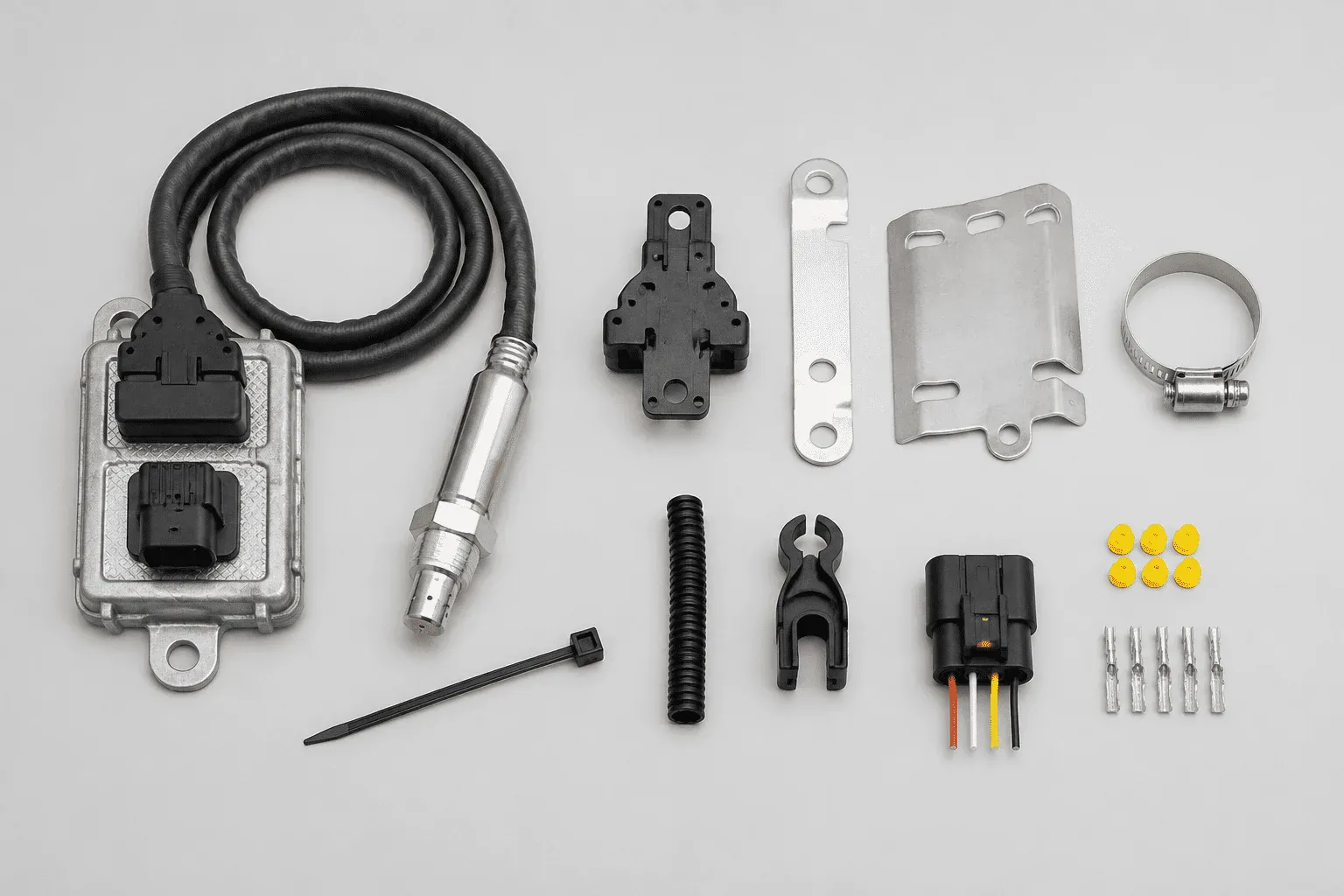
A typical NOx sensor consists of:
Sensor Probe → Cable → Control Module → Connector
The label on the control module contains the information you need. Look for the following fields:
2. Take a Clear Photo of the Label
Instead of writing down just one number, take a clear photo of the entire NOx sensor label.
A good photo should capture:
- The whole label, in focus
- Every field — not just the P/N
- Enough light to read the smallest text (HW/SW versions are often tiny)
If the sensor is already out of the vehicle, photograph the label before cleaning or handling the sensor further — ink on these labels can fade or rub off.
3. Search the Part Number
Once you have the P/N, search it online or in a parts catalog. A search for the part number usually tells you:
- Compatible engines
- Compatible vehicles
- Upstream or downstream position
- OEM replacement number
- Cross-reference number
- Updated part number
4. Identify Upstream or Downstream
Many modern diesel SCR systems use more than one NOx sensor. A simplified aftertreatment flow looks like this:
Engine → DOC → DPF → Upstream NOx Sensor → SCR → Downstream NOx Sensor → Exhaust
Upstream NOx Sensor
The upstream sensor measures NOx before or around the SCR treatment stage. Its readings drive how much Diesel Exhaust Fluid (DEF) the system injects.
Downstream NOx Sensor
The downstream sensor measures NOx after SCR treatment. It helps the ECU evaluate how well the SCR system is performing and can trigger derates when efficiency drops.
5. Search by VIN
If the original sensor label is damaged or unreadable, you can often identify the correct NOx sensor using the vehicle VIN.
A VIN is a 17-character vehicle identification number. It can usually be found on:
- The driver-side dashboard
- The driver-side door label
- Vehicle registration
- Insurance documents
- Service records
An OEM dealer or a compatible parts catalog can use the VIN to look up the vehicle's original configuration and the sensors fitted to it.
6. Search by Engine Serial Number
For heavy-duty diesel trucks, the Engine Serial Number (ESN) is especially useful for narrowing down the correct sensor.
This works particularly well for engines from:
- Cummins
- Detroit
- PACCAR
- Volvo
- Mack
- International / Navistar
- FPT Industrial
The engine serial number can usually be found on the engine identification plate.
For heavy-duty vehicles, the most accurate search combines several identifiers:
Vehicle + Model Year + Engine Model + ESN + Sensor Position
For example:
2022 Freightliner Cascadia + Detroit DD15 + Downstream NOx Sensor
This is far more accurate than searching only for "Freightliner NOx Sensor".
7. Check for Superseded Part Numbers
Sometimes an older NOx sensor part number is replaced by a newer one:
Original P/N → Updated P/N → Current Replacement P/N
This is called part-number supersession. Manufacturers update part numbers when they improve the design, change suppliers, or consolidate SKUs.
8. Check the Manufacturer Part Number
A single NOx sensor may carry more than one part number:
- OEM P/N — assigned by the vehicle manufacturer
- Manufacturer P/N — assigned by the sensor manufacturer
The vehicle manufacturer may use its own OEM number while the sensor manufacturer (such as Bosch or NGK) uses a different one. If a search on the OEM number turns up nothing, try searching the manufacturer's number as well.
9. What If the Sensor Label Is Missing?
If the label is damaged, missing, or unreadable, collect as much vehicle information as you can:
The more information you provide, the easier it is to confirm the correct NOx sensor.
10. How to Check NOx Sensor Tester Compatibility
After identifying the NOx sensor part number, compare it with the supported sensor list for your NOx Sensor Tester. The recommended process:
Step 1 — Find the NOx sensor label → Step 2 — Find the P/N → Step 3 — Identify upstream or downstream → Step 4 — Record the engine model → Step 5 — Check the supported part-number list → Step 6 — Contact technical support if the number is not listed
The Fastest Way to Identify Your NOx Sensor
For most users, the fastest method is:
- Find the NOx sensor.
- Take a clear photo of the label.
- Find the P/N or Part Number.
- Identify whether it is upstream or downstream.
- Record the engine model.
- Search or verify the exact part number.
Key Takeaways
- The Part Number (P/N) on the sensor control module label is the most reliable identifier
- Vehicle brand alone is not enough — engine, model year, emissions system, and position all matter
- Upstream and downstream sensors can look identical but have different part numbers
- If the label is unreadable, search by VIN (for vehicles) or ESN (for heavy-duty trucks)
- Always check whether the part number has been superseded by a newer one
- Verify tester compatibility against the supported part-number list before testing
Need Help Finding Your NOx Sensor Model?
If you are not sure which NOx sensor you have, send us:
- NOx Sensor Part Number
- Engine Model
- Vehicle or Equipment Model
- Model Year
- Upstream or Downstream
- A Clear Photo of the Sensor Label
We can help you identify the sensor and check whether it is compatible with your NOx Sensor Tester.
Need help identifying your NOx sensor? Contact Proformanceusa Diagnostics — send us the part number, engine model, and a clear photo of the label, and we'll verify compatibility with your NOx Sensor Tester.