A dedicated NOx sensor testing tool can help technicians investigate sensor operation beyond the fault codes reported by the truck. While a conventional heavy duty diagnostic scanner communicates with vehicle control modules, a compatible NOx sensor tester tool may communicate directly with an individual sensor. The exact testing capabilities depend on the equipment and supported sensor models. For a diesel repair shop, the most useful checks generally fall into four categories. NOx Sensor CAN…
NOx Sensor Testing: What Can a Dedicated Tester Check?

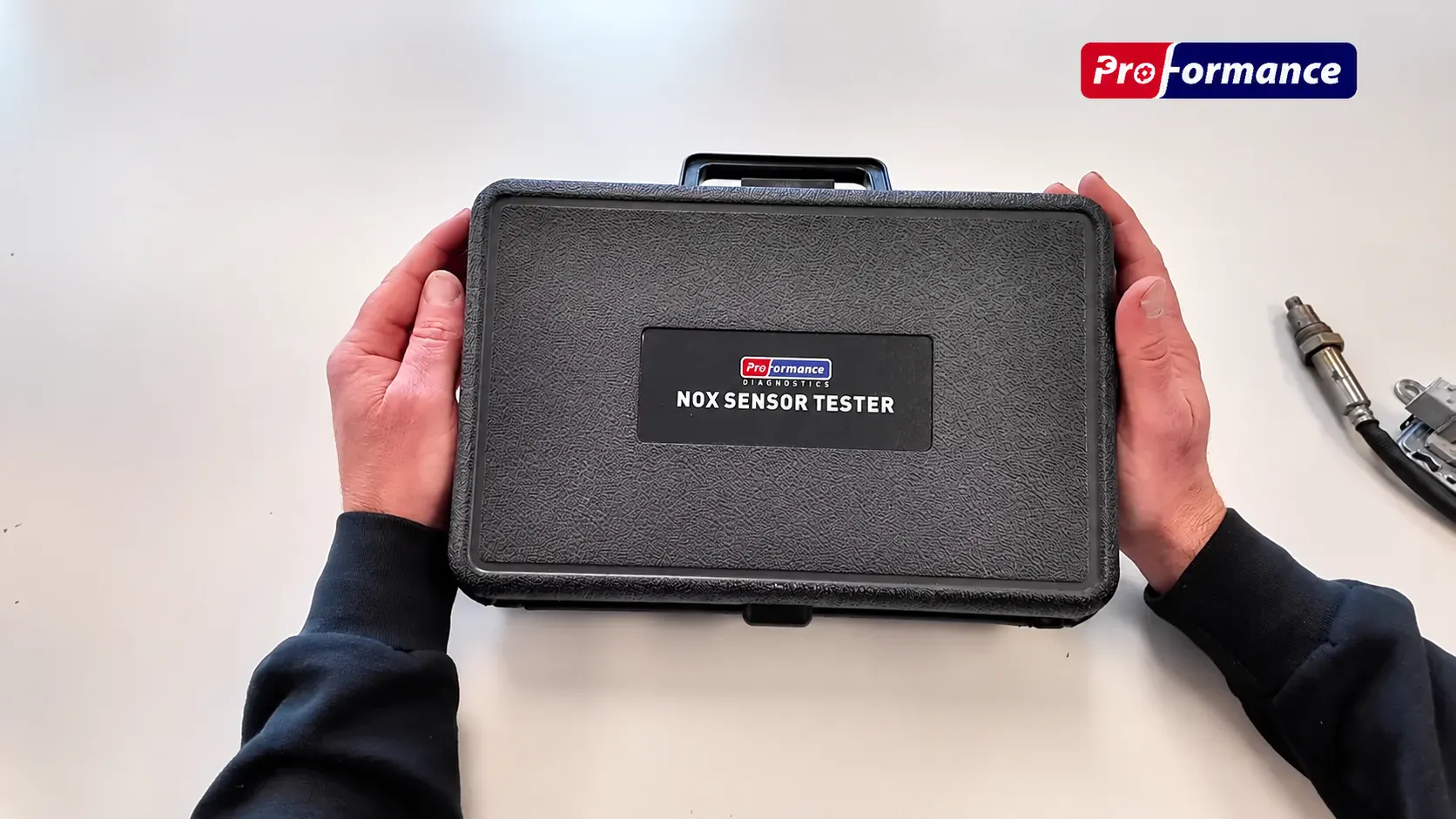
A dedicated NOx sensor testing tool can help technicians investigate sensor operation beyond the fault codes reported by the truck.
While a conventional heavy-duty diagnostic scanner communicates with vehicle control modules, a compatible NOx sensor tester tool may communicate directly with an individual sensor.
The exact testing capabilities depend on the equipment and supported sensor models.
For a diesel repair shop, the most useful checks generally fall into four categories.
NOx Sensor CAN Communication Test
Many modern NOx sensor assemblies communicate electronically with the vehicle through a CAN-based interface.
When a sensor stops reporting data, the problem may involve the sensor electronics, its electrical supply, wiring, or communication network.
A compatible tester can help determine whether the sensor responds under the test conditions.
In the Proformance Diagnostics demonstration, the tester connects to a returned NOx sensor and automatically identifies it as an inlet sensor associated with a Cummins/PACCAR application.
Successful communication provides useful evidence that the sensor's communication electronics are functioning during that test.
However, a successful bench connection cannot confirm that the original vehicle's CAN wiring or electrical connections are healthy.
If the sensor communicates correctly on the bench but fails to communicate when installed, the technician should investigate the vehicle-side wiring and power supply.
NOx Sensor Heater Test
NOx sensors generally require controlled heating before their measurements become meaningful.
During a NOx sensor heater test, technicians should observe whether the sensor reaches its expected operating state under the equipment manufacturer's specified conditions.
In the demonstration, the Proformance tester shows heating progress before the sensor begins reporting stable measurements.
A sensor that fails to complete the expected heating sequence may require further investigation.
Possible causes include:
Incorrect power supply
Damaged electrical connections
Sensor heater malfunction
Internal electronics failure
Incompatible testing equipment
The heater circuit and sensing element should not be judged solely from an initial reading taken before warm-up is complete.
Safety note: NOx sensor probes can become extremely hot during operation. Keep the probe away from combustible materials and avoid touching it during or immediately after testing.
Live NOx Sensor Readings
One of the most useful features of a compatible NOx sensor tester is the ability to display reported nitrogen oxide concentration.
NOx values are commonly expressed in parts per million (ppm).
During the featured bench test, the sensor's reported NOx reading decreases as the testing procedure progresses.
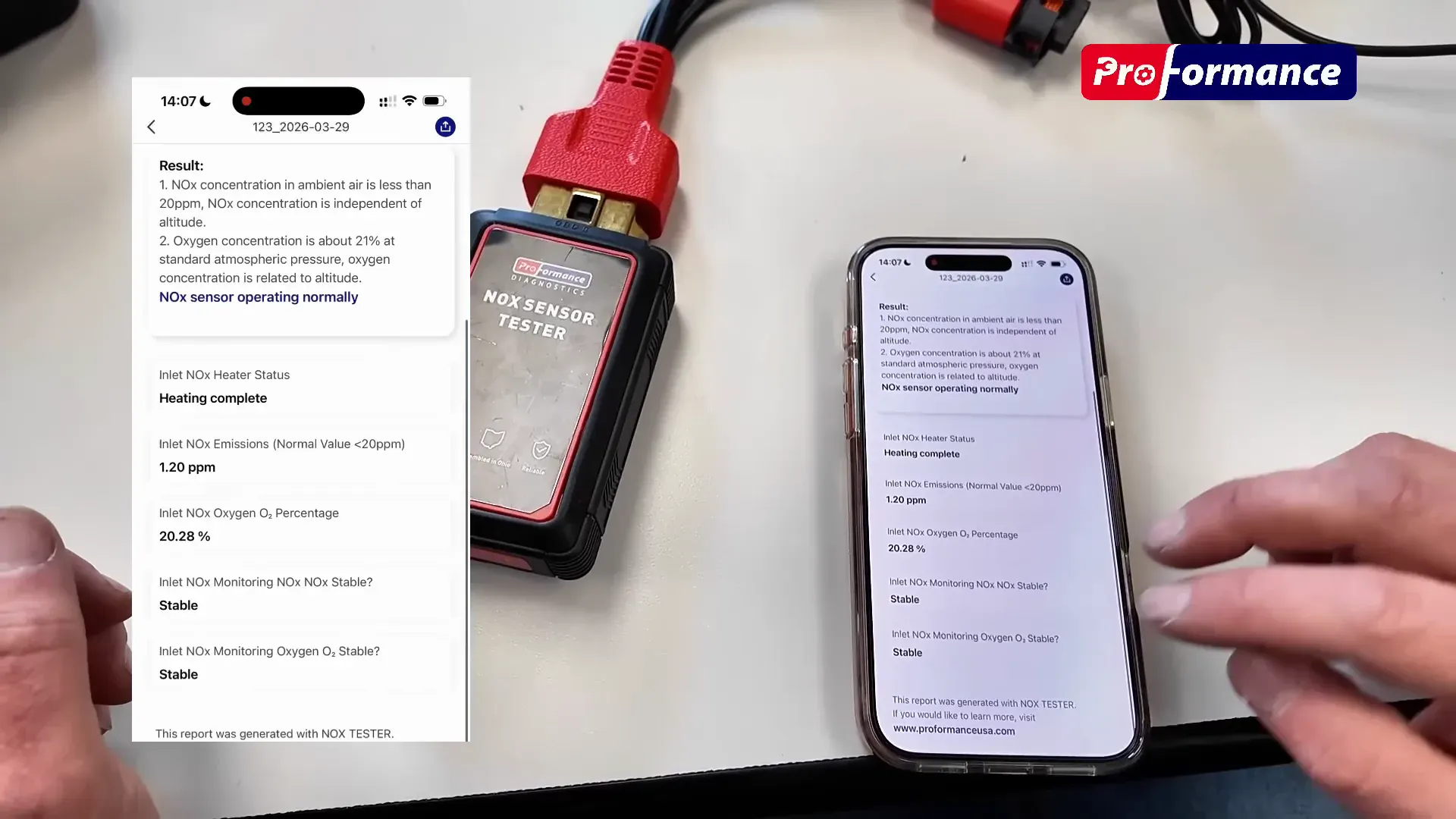
The final recorded value is 1.2 ppm.
For this demonstrated ambient-air procedure, the presenter uses a reading below 20 ppm as part of the equipment-specific evaluation.
This should not be interpreted as a universal specification for NOx sensors.
The expected value depends on the sensor, environment, testing method, and operating state.
Oxygen Sensor Data
Some NOx sensor testers can also display oxygen concentration reported by the sensor.
In the Proformance demonstration, the final recorded oxygen reading is 20.28%.
This is reasonably close to the oxygen concentration normally present in ambient air.
The reading is useful in the context of the demonstrated procedure, but it does not replace a calibrated measurement or prove sensor accuracy across its operating range.
The combination of valid communication, successful heating, stable NOx readings, and plausible oxygen data provides a more complete picture than any one measurement alone.
Upstream vs. Downstream NOx Sensor Testing
Understanding sensor position is important when interpreting NOx sensor testing results.
Many heavy-duty diesel engines equipped with selective catalytic reduction systems use NOx sensors at different points in the exhaust aftertreatment system.
Upstream NOx Sensor
An upstream NOx sensor is positioned before the SCR catalyst.
It measures NOx entering the SCR treatment stage and may support the system's control strategy.
Depending on the exhaust configuration, this sensor may also be described as an inlet NOx sensor.
Downstream NOx Sensor
A downstream NOx sensor is installed after the SCR catalyst.
Its measurements help the vehicle monitor emissions performance and, depending on the system design, evaluate SCR effectiveness.
What Is the Difference When Testing?
Feature | Upstream NOx Sensor | Downstream NOx Sensor |
|---|---|---|
Position | Before SCR catalyst | After SCR catalyst |
Main measurement | NOx entering treatment | NOx after treatment |
Diagnostic relevance | Incoming NOx measurement | SCR performance monitoring |
Electrical testing | Depends on sensor compatibility | Depends on sensor compatibility |
Bench testing | Possible with supported testers | Possible with supported testers |
A technician should not assume that upstream and downstream sensors are interchangeable.
Part numbers, connectors, calibration, and communication requirements may differ.
The featured Proformance demonstration uses an inlet NOx sensor. It does not demonstrate a simultaneous upstream/downstream comparison under operating exhaust conditions.
For a complete SCR diagnosis, reported NOx measurements must be interpreted alongside engine load, temperature, DEF dosing, and the manufacturer's control strategy.
How to Interpret NOx Sensor Test Results
A NOx sensor bench test can provide useful diagnostic evidence, but the results need to be interpreted correctly.
The most important question is not simply whether the tester reports a pass or fail.
It is whether the measurements support a reasonable conclusion about the sensor under the conditions tested.
Result 1: Sensor Communication Failure
If the sensor fails to communicate with the tester, first verify the test setup.
Check the power supply, adapter, connector condition, sensor compatibility, and approved connection procedure.
If those conditions are correct and communication still fails, further sensor-specific diagnosis may be necessary.
Result 2: Heater Does Not Reach Operating Status
An incomplete warm-up sequence may indicate an electrical or sensor problem.
However, low supply voltage or incorrect testing conditions can also affect the result.
Confirm the required conditions before concluding that the sensor is defective.
Result 3: NOx Reading Is Unstable
A changing NOx reading is not necessarily abnormal during warm-up.
In the featured video, the reported NOx concentration changes before settling at a stable value.
Readings should be evaluated only after the appropriate operating state has been reached.
Result 4: Sensor Passes Bench Testing
In the Proformance demonstration, the returned sensor:
Communicates with the tester.
Completes the heating sequence.
Reports stable measurements.
Records 1.2 ppm NOx.
Records 20.28% O₂.
Receives an operating-normal assessment.
These results support the conclusion that the sensor performed normally during the demonstrated bench procedure.
They do not establish that the original vehicle's SCR system was working correctly or that the sensor would perform normally under all exhaust conditions.
If a truck continues reporting NOx-related faults after a sensor passes independent testing, vehicle-side diagnosis remains necessary.
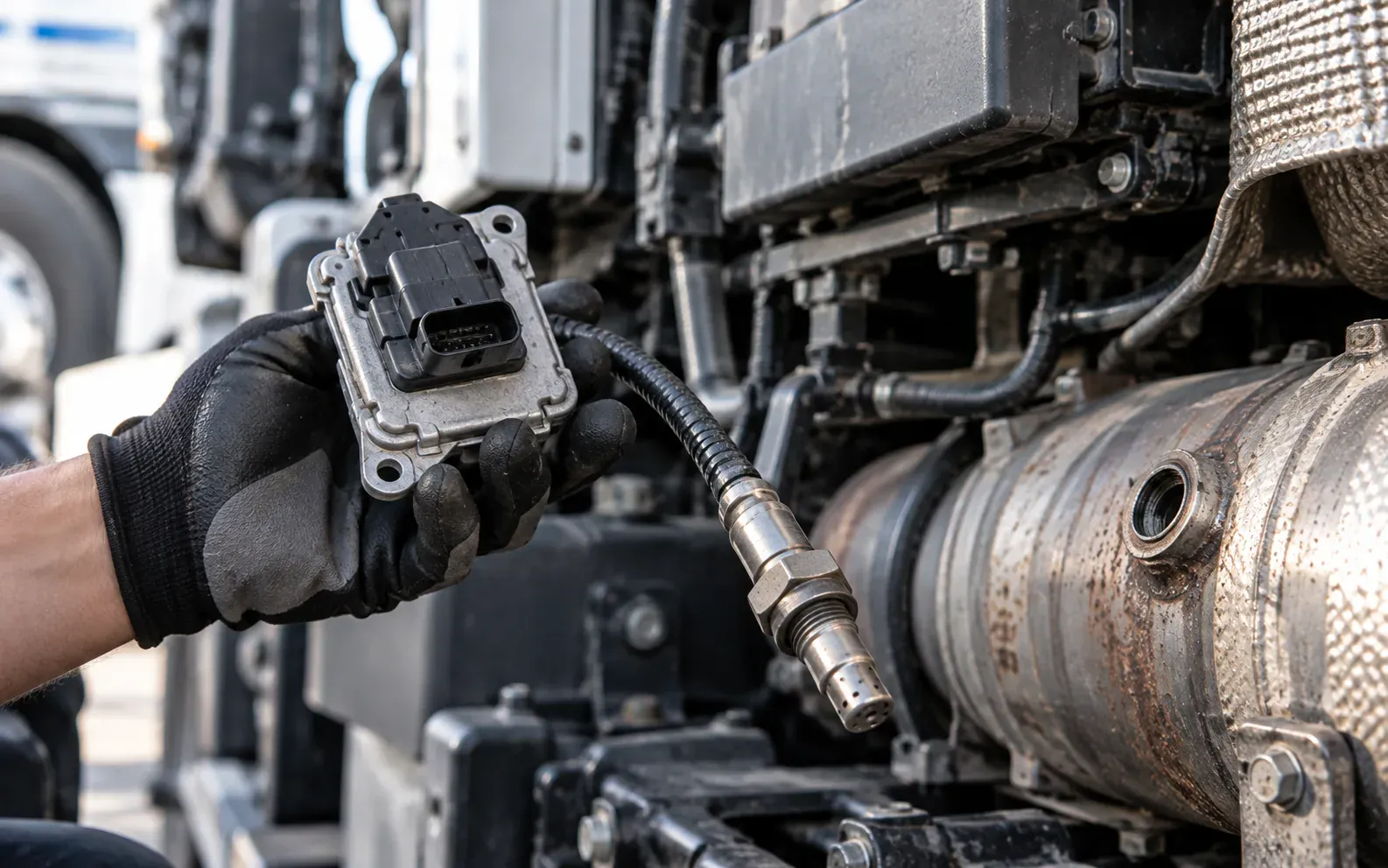
Removing a NOx sensor from an exhaust system can be difficult, especially when corrosion and repeated heat cycles have affected the mounting threads.
In some cases, a compatible NOx sensor tester can help technicians test the sensor while leaving the probe installed in the exhaust.
The general procedure is:
Turn off the engine and allow hot exhaust components to cool as required.
Identify the correct NOx sensor and electrical connector.
Disconnect the sensor from the vehicle harness according to the service procedure.
Connect the approved NOx sensor tester adapter.
Supply power using the tester manufacturer's specified method.
Run the supported communication and sensor operating checks.
Review the results before deciding whether further diagnosis or replacement is necessary.
This approach can reduce unnecessary sensor removal.
However, it is important to understand its limitations.
Testing the sensor through an independent electrical connection does not confirm the integrity of the vehicle harness.
If the sensor responds normally to the dedicated tester but not to the vehicle, investigate the electrical supply, communication wiring, connectors, and relevant control systems.
The Proformance video describes this testing approach, but the featured demonstration itself is conducted on a workbench.
Choosing a NOx Sensor Testing Machine for Diesel Trucks
When selecting a NOx sensor testing machine, the most important consideration is compatibility with the sensors your shop actually services.
A tester with many advertised functions is not necessarily useful if it cannot communicate with the sensor models installed on your customers' trucks.
Before purchasing, consider the following factors.
Supported Sensor Models
Check the manufacturer's compatibility list for supported part numbers, electrical requirements, and connector configurations.
Communication Diagnostics
A tester that reports communication status can help technicians investigate suspected sensor electronics problems.
Heater Monitoring
Operating-state and heater-status information can be useful when diagnosing warm-up concerns.
Live Sensor Data
Check whether the tester can display NOx ppm, O₂ percentage, and other information relevant to the supported sensor.
Test Reports
For repair shops and parts distributors, saving test results can support service documentation and warranty evaluation.
 Power and Portability
Consider whether the tester supports the power sources and working environments used by your shop.
Software Updates
Confirm the manufacturer's update policy and supported sensor list.
In the Ryan Fox demonstration, the Proformance NOx Sensor Tester provides automatic identification, Bluetooth app communication, live readings, and diagnostic report generation.
These are demonstrated capabilities of the featured product, not features guaranteed on every tester.